Relivo
One platform to build, test, publish, and run AI agent workflows.
Relivo brings workflow orchestration, memory, observability, chat, API access, and deployment into one product stack for teams building AI agents.
Status
Work in progress
Frontend
Next.js, React, Tailwind, Clerk
Backend
FastAPI, SSE, S3 uploads, OpenAI
Focus
Agent orchestration and deployment
Overview
Overview
Relivo is an agent orchestration platform for teams that want AI workflows in production without rebuilding the same infrastructure every time.
The MVP focuses on one complete loop: create a workflow, test it, publish a version, and use it through chat or API.
4 steps
Core flow
Create, test, publish, run.
Chat/API
Channels
Embeddable UI and SDKs planned.
FE + BE
Stack
Separate frontend and backend repos.
Current Build Scope
Workspace
Teams, members, environments, credentials
Agents
Models, instructions, skills, tools, memory
Workflows
Handoffs, conditions, retries, final response
MCP
External tools, APIs, business systems
Deployments
Published workflow versions
Observability
Logs, usage, latency, streamed events
01
Problem Statement
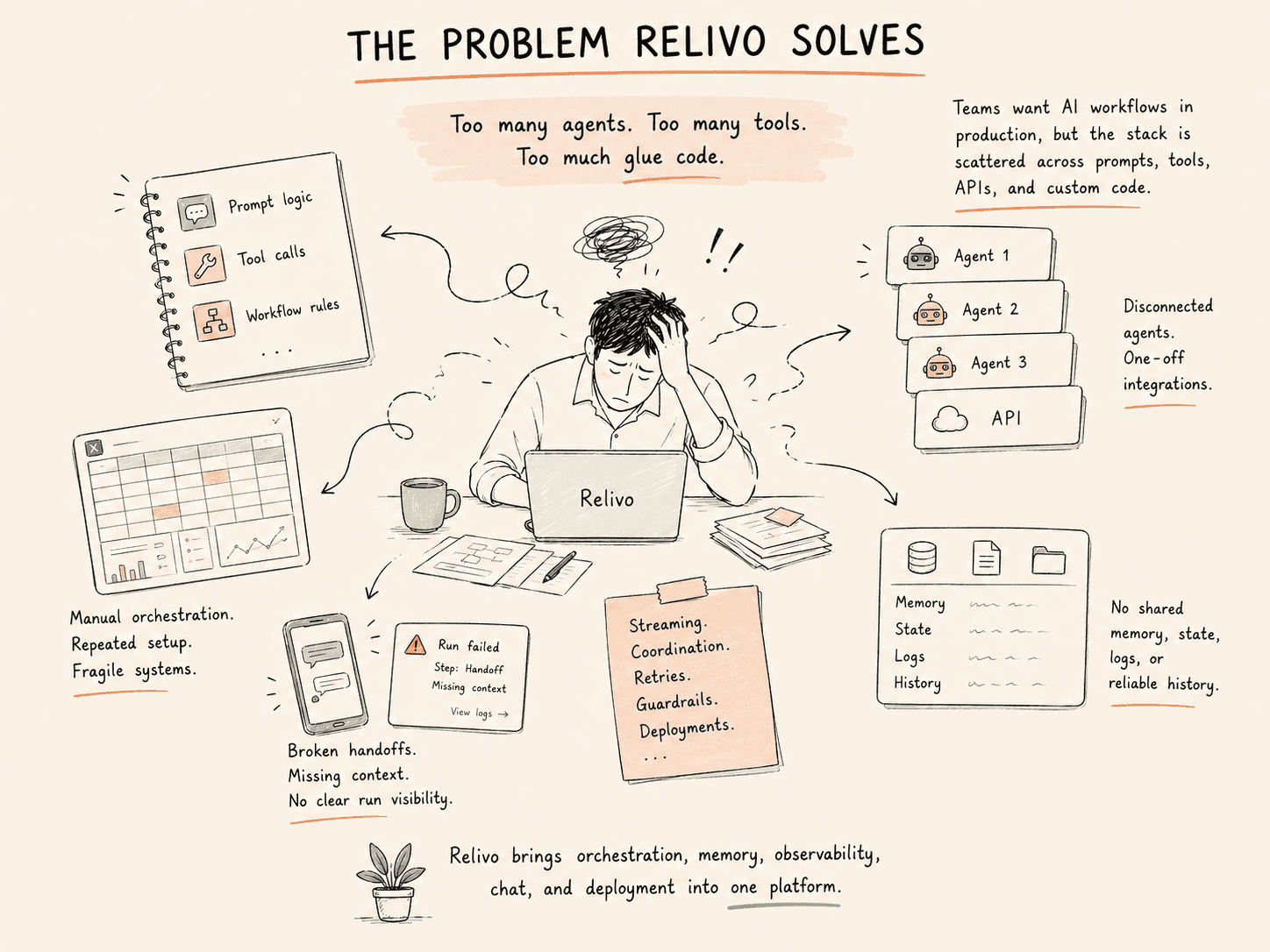
AI teams keep rebuilding the same agent infrastructure.
Prompts, tool calls, memory, logs, deployments, and chat UI often live in separate places.
That creates glue code, fragile handoffs, and poor run visibility.
Too many one-off integrations.
No shared memory or state.
Hard to debug failed runs.
Repeated setup for every agent workflow.
02
Solution
Build once. Test. Publish. Run anywhere.
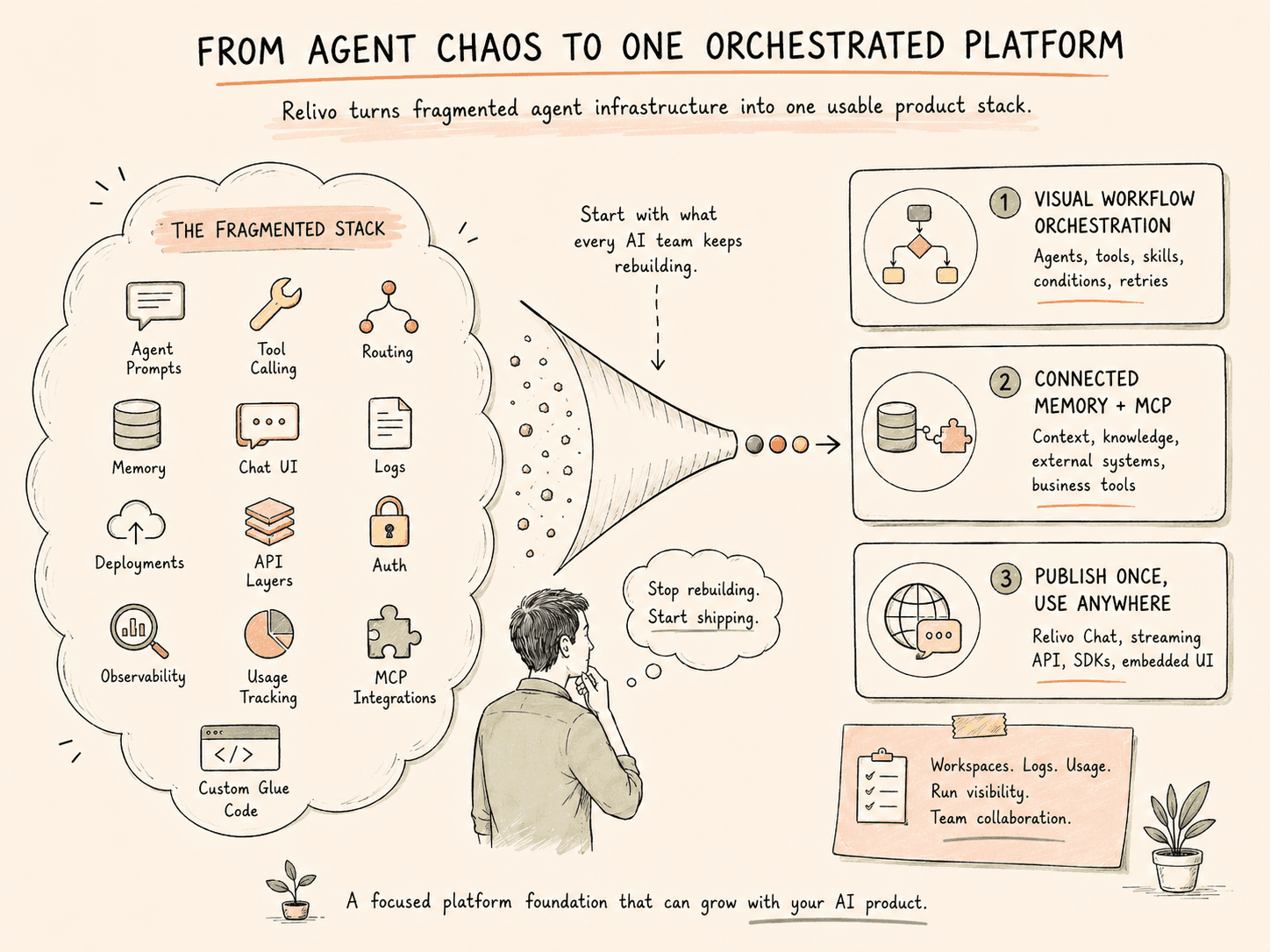
Relivo turns fragmented agent infrastructure into one usable product stack.
Teams can orchestrate workflows visually, connect tools, publish versions, and consume them through chat or API.
Visual orchestration
Agents, tools, skills, conditions, retries, and handoffs in one workflow.
Connected memory + MCP
Shared context with external tools, APIs, and business systems.
Publish once
Use workflows through Relivo Chat, streaming API, SDKs, or embedded UI.
03
How It Helps
Relivo reduces the hidden work around production agents.
The goal is not just to run agents. It is to make them visible, reusable, and easier to ship with a team.
Faster setup for new workflows.
Clearer debugging through run events.
Reusable deployments for production use.
Less glue code across chat, tools, APIs, and logs.
04
Architecture
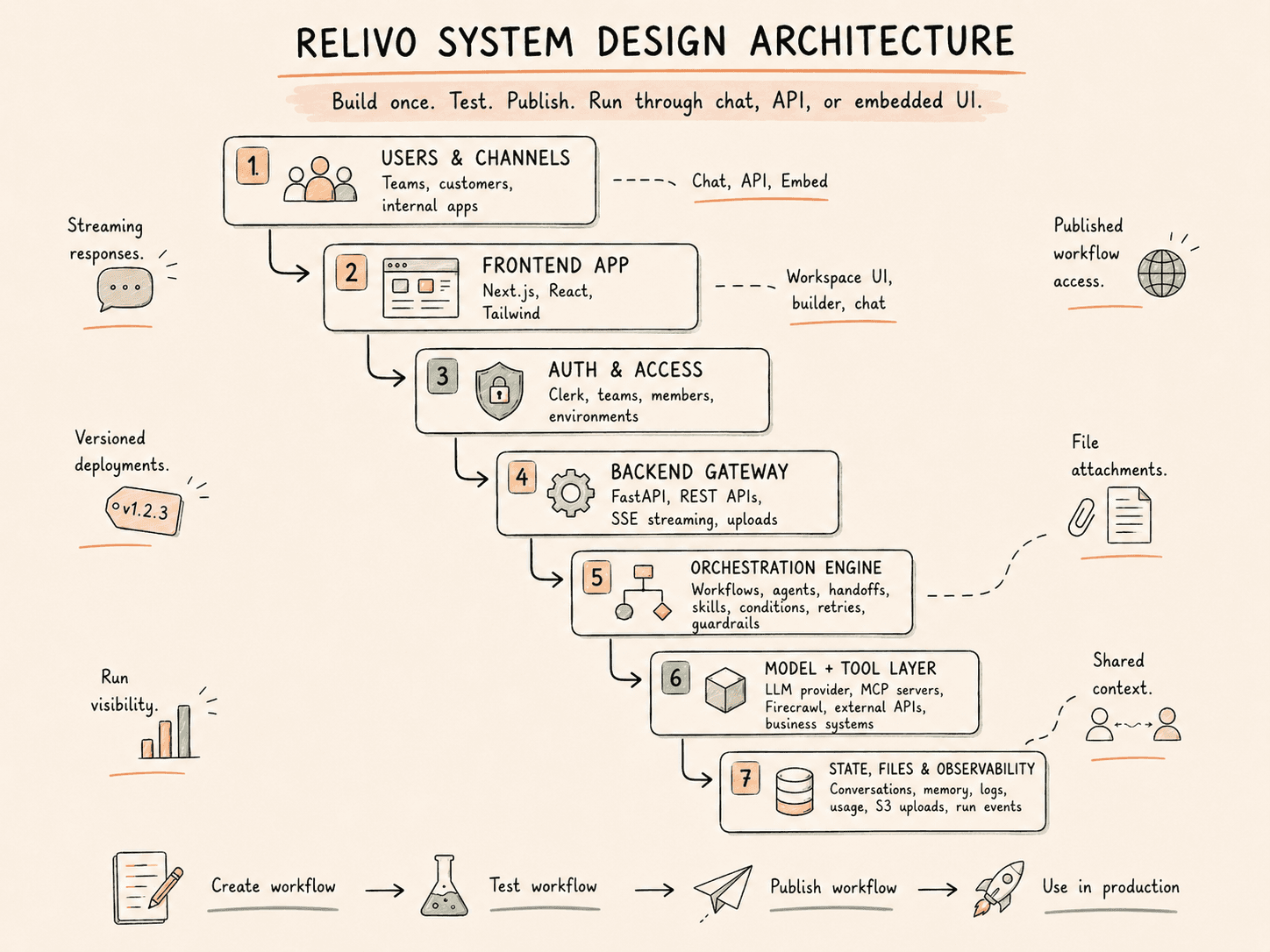
A layered system for workflow creation and execution.
The frontend handles the workspace, builder, chat, docs, and authenticated app shell.
The backend provides streaming chat, uploads, conversations, files, and model/tool execution.
Next.js frontend with Clerk and TanStack Query.
FastAPI backend with Server-Sent Events.
OpenAI model streaming and reasoning support.
S3-backed file upload and attachment flow.
05
MVP Scope
One complete flow before broad platform expansion.
The first version is intentionally focused: create workflow, test workflow, publish workflow, and use it in production.
Workspace + auth
Teams, members, environments, credentials, logs, and usage.
Agent setup
Model configuration, instructions, tools, memory, and guardrails.
Run visibility
Workflow path, model calls, tool calls, latency, tokens, and errors.
06
Current State
The foundation is in progress.
The frontend includes public pages, authenticated chat, conversation history, settings, connectors, and streaming integration.
The backend includes chat streaming, uploads, conversations, file APIs, and model integration.
Reflection
What I am shaping next
The next challenge is making the workflow builder feel simple without hiding the power needed for real production agent systems.
The product needs to stay focused: visible runs, reliable handoffs, reusable deployments, and clear developer onboarding.
View More Projects