E-commerce REST API in Go
Go E-commerce API
E-commerce REST API in Go — JWT auth, product catalog, cart, and orders, with S3 uploads and SQS-backed domain events. Built with gin, GORM, and Postgres.

Documentation
go-ecommerce
E-commerce REST API in Go — auth, catalog, cart, orders, image uploads, and domain events.
github.com/Hitesh-s0lanki/go-ecommerce
Stack
| Concern | Choice |
|---|---|
| Language | Go 1.26 |
| HTTP | gin v1.12.0 |
| ORM | GORM v1.31.2 + Postgres driver v1.6.0 |
| Migrations | golang-migrate v4.19.1 (versioned SQL) |
| Auth | golang-jwt/jwt v5.3.1 (HS256) + bcrypt (golang.org/x/crypto) |
| Messaging | Watermill v1.5.2 + watermill-aws over SQS |
| Storage | AWS SDK v2 — S3 (or local disk) |
| API docs | swaggo v1.16.6 → Swagger UI |
| Logging | zerolog v1.35.1 |
| Config | godotenv v1.5.1 + environment |
| Lint | golangci-lint v2.12.2 |
Docker images
| Image | Role | Port |
|---|---|---|
postgres:18.4-alpine | Database | 5432 |
localstack/localstack:4.0 | S3 + SQS, local | 4566 |
nginx:1.27-alpine | CDN fronting uploads | 8081 |
Quick start
git clone https://github.com/Hitesh-s0lanki/go-ecommerce.git
cd go-ecommerce
cp .env.example .env
make tools       # pinned dev tooling
make hooks       # git hooks
make docker-up   # Postgres, LocalStack, CDN
make migrate-up  # schema
make run         # http://localhost:8080
Docs: http://localhost:8080/swagger/index.html (disabled in release mode).
Layout
cmd/api/            entrypoint: config, database, HTTP server, graceful shutdown
db/migrations/      versioned SQL — the source of truth for the schema
docker/             compose file, LocalStack init, nginx CDN config
internal/auth/      password hashing, JWT issue/verify
internal/config/    environment loading and validation
internal/database/  Postgres connection, pooling, health check
internal/dto/       request/response shapes and model mappers
internal/events/    SQS publisher
internal/logger/    zerolog setup
internal/models/    GORM models
internal/server/    gin engine, middleware, handlers
internal/storage/   upload providers (local, S3)
internal/utils/     HTTP response envelope
Endpoints
| Method | Path | Access |
|---|---|---|
GET | /health | public — liveness, never touches the DB |
GET | /health/ready | public — readiness, pings the DB |
POST | /api/v1/auth/register | public |
POST | /api/v1/auth/login | public |
POST | /api/v1/auth/refresh | public — rotates the token |
POST | /api/v1/auth/logout | public |
GET | /api/v1/auth/me | user |
GET | /api/v1/users/profile | user — same as /auth/me |
PUT | /api/v1/users/profile | user — name and phone only |
GET | /api/v1/categories | public |
GET | /api/v1/products | public |
GET | /api/v1/products/:id | public |
GET | /api/v1/cart | user |
POST | /api/v1/cart/items | user |
PUT | /api/v1/cart/items/:id | user |
DELETE | /api/v1/cart/items/:id | user |
POST | /api/v1/orders | user |
GET | /api/v1/orders | user |
GET | /api/v1/orders/:id | user |
POST | /api/v1/categories | admin |
PUT | /api/v1/categories/:id | admin |
DELETE | /api/v1/categories/:id | admin |
POST | /api/v1/products | admin |
PUT | /api/v1/products/:id | admin |
DELETE | /api/v1/products/:id | admin |
POST | /api/v1/products/:id/images | admin |
One envelope for every response:
{ "success": true, "message": "ok", "data": { "status": "ok" } }
Error detail is returned only for 4xx. A 5xx returns a generic message and logs
the detail. Every request carries an X-Request-ID (an inbound one is reused).
CORS comes from ALLOWED_ORIGINS.
Make targets
make help lists all of them.
| Target | Does |
|---|---|
run / dev | Run the API |
build | Compile to bin/api |
test | Tests with the race detector |
test-integration | Also tests needing Postgres |
lint / lint-fix | Lint, optionally autofixing |
fmt / fmt-check | Format, or show the diff |
docs / docs-check | Regenerate Swagger spec / fail if stale |
ci | tidy + vet + lint + test |
docker-up / docker-down / docker-reset | Containers (reset drops volumes) |
migrate-up / migrate-down / migrate-status | Apply / roll back one / show version |
migrate-create name=add_widgets | Scaffold a migration pair |
Design notes
<details> <summary><b>Auth</b> — token separation, HS256 pinning, bcrypt limits</summary>Access and refresh tokens are not interchangeable. Both are signed with the
same secret, so a signature alone proves only that a token is ours — not what it
is for. Every token carries a use claim and ParseAccessToken rejects a
refresh token; otherwise a 72-hour refresh token authenticates anywhere a
24-hour access token does.
- HS256 is pinned at parse time — a parser that trusts the token's own header is the root of the classic JWT confusion attacks
expis required; a token without one is valid forever- Every token carries a
jti, so one session can be revoked without dropping the rest JWT_SECRETmust be ≥32 bytes, checked at startup. Generate withopenssl rand -hex 32- Passwords over 72 bytes are rejected, not truncated — bcrypt reads only the first 72, so a longer one would authenticate on a prefix. Cost is 12, not the library default of 10
Protect routes with srv.Authenticate(), gate admin routes with
srv.RequireAdmin() after it. Handlers read the caller via CurrentUserID,
CurrentUserEmail, CurrentUserRole.
Only a SHA-256 hash of each refresh token is stored, never the token — a database leak must not hand out working sessions. Plain SHA-256 rather than bcrypt is correct here: the token is already high-entropy, so there is nothing to brute force.
Refresh rotates: the presented token is revoked as the new pair is issued, so any refresh token works exactly once. Replaying a rotated token is treated as theft — a legitimate client never does it — and every session for that user is revoked.
Login is uniform: wrong password, unknown email, and deactivated account all return the same error, and an unknown email still pays for a bcrypt comparison so it cannot be identified with a stopwatch.
</details> <details> <summary><b>Models</b> — integer cents, partial unique indexes</summary>Nine models: User, RefreshToken, Category, Product, ProductImage,
Cart, CartItem, Order, OrderItem. models.All() lists them in dependency
order and is the single source of truth for migrations and tests.
Money is integer cents (PriceCents, TotalAmountCents, UnitPriceCents),
never a float — binary floating point cannot represent decimal cents exactly, so
summing line items drifts. 1999 means $19.99.
Unique indexes are partial (WHERE deleted_at IS NULL). Everything soft
deletes, and a plain unique index would let a deleted row reserve its email or
SKU forever.
OrderItem snapshots the price at purchase; CartItem deliberately does not, so
carts always price from the current product.
Binding a request straight onto a model invites mass assignment — a caller
setting Role: "admin" on registration — and serialising models back leaks
columns as they are added. UserResponse has no password field by construction
rather than by remembering a json:"-" tag.
Requests are validated with gin's binding tags. Prices cross the wire as
price_cents, matching the models; accepting decimals would reintroduce the
float rounding the schema avoids.
The models never migrate themselves. AutoMigrate builds throwaway schemas in
tests only, so db/migrations/ stays the single source of truth
for the real database.
The SQL is kept equivalent to the models: applying the migrations and running
AutoMigrate produce a byte-identical schema. Change a model, change the
migrations — nothing enforces this automatically.
</details> <details> <summary><b>Domain events</b> — best-effort SQS publishing</summary>Postgres volume: Postgres 18 stores data in
/var/lib/postgresql/18/dockerand expects the volume at/var/lib/postgresql. The pre-18 path (/var/lib/postgresql/data) is not interchangeable.
Registering and logging in publish to SQS (user.registered, user.logged_in),
so work that is not the caller's concern — a welcome email, an analytics record —
happens elsewhere. EVENTS_ENABLED=false discards them and the API runs with no
queue.
Publishing is best-effort: a queue outage is logged, never a failed login. The cost is that an event can be dropped, which is the right trade for these two. If one ever must not be lost — payment taken, order placed — write it to the database in the same transaction and have a relay publish it.
Refreshing a token publishes nothing: that is a session continuing, not a person logging in.
The queue must already exist (the LocalStack init script creates it). The
publisher will not create one, so a typo in AWS_EVENT_QUEUE_NAME fails loudly.
UPLOAD_PROVIDER decides where product images are stored: local writes to
UPLOAD_PATH, s3 writes to the LocalStack bucket. UPLOAD_PUBLIC_BASE_URL
decides where clients fetch them, and the two are independent.
Left empty, the API serves its own files at /uploads — fine for development,
but only with the local provider. Point it at the CDN instead:
UPLOAD_PUBLIC_BASE_URL=http://localhost:8081/uploads
and one URL serves either provider: nginx returns the file from disk if the local
provider wrote it, and proxies the bucket if not. Switching UPLOAD_PROVIDER
needs no other change, and the API stops serving bytes — which is what production
looks like.
Configuration comes from .env (copy .env.example). The Makefile reads the
same file, so make migrate-* targets the database configured there. Real
environment variables take precedence.
GIN_MODE drives more than routing: release switches logs to JSON, quiets GORM
statement logging, and makes a default JWT_SECRET a startup error rather than a
warning. Config is validated at startup, so a malformed duration or size fails
immediately instead of silently becoming zero.
make hooks points core.hooksPath at .githooks/ — plain shell,
nothing extra to install.
| Hook | Runs | Why there |
|---|---|---|
pre-commit | format check + lint | Fast, and only when Go files are staged |
pre-push | go vet + go test -race | Too slow per commit; still blocks broken code from the remote |
Bypass with --no-verify; disable with make unhooks.
Linters live in .golangci.yml and run in CI on every push to
main and every PR. On top of the standard set (errcheck, govet,
ineffassign, staticcheck, unused): bodyclose, errorlint, gocritic,
gosec, misspell, revive, unconvert. Formatting is gofmt + goimports,
with local imports grouped separately.
Requirements
- Go 1.26+
- Docker
make toolsinstalls golangci-lint and golang-migrate at pinned versions
License
Not yet specified. </content> </invoke>
Keep exploring
Related work
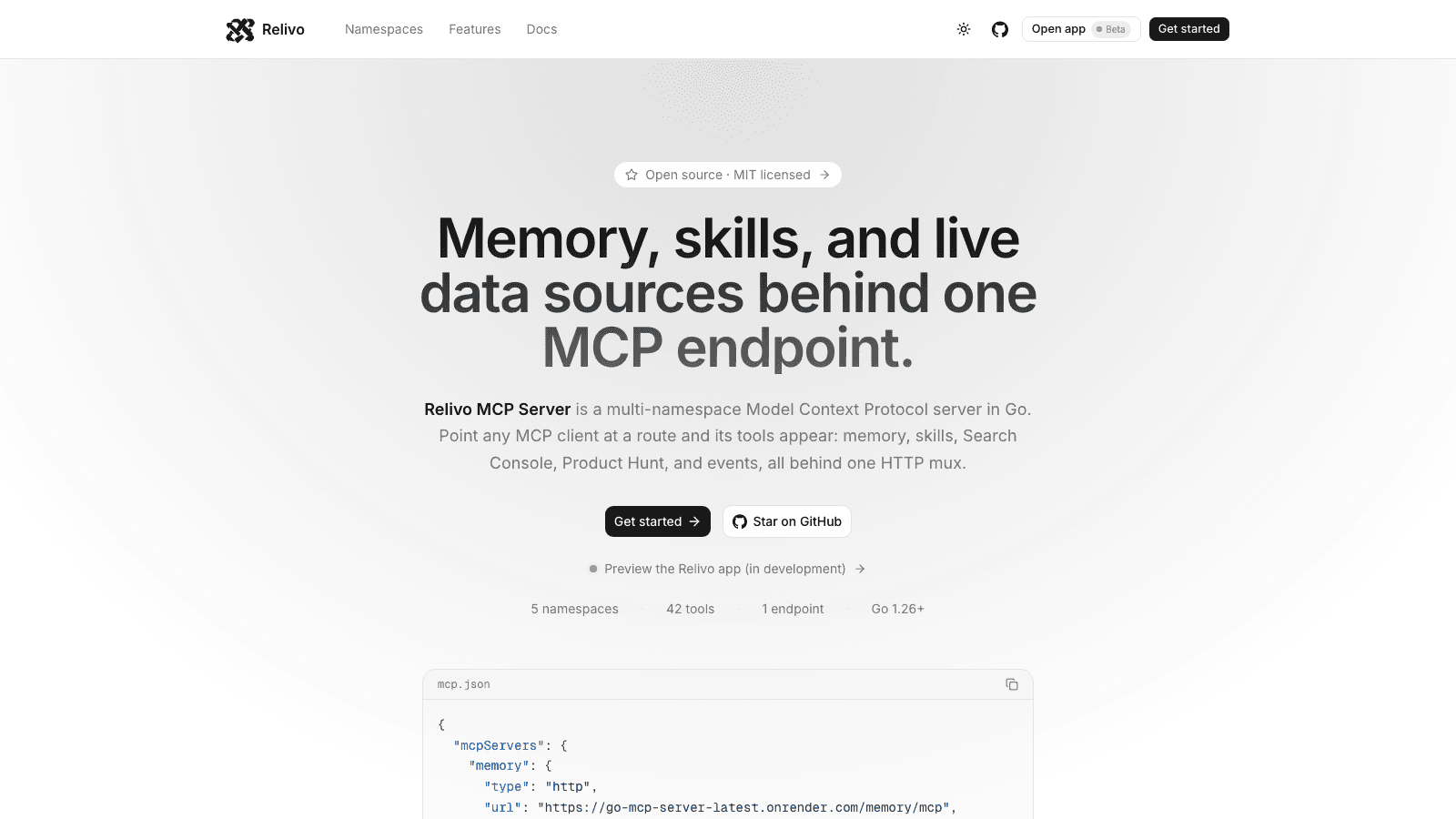
Relivo MCP Server
Multi-namespace Model Context Protocol server in Go — memory, skills, events, Search Console, and Product Hunt tools mounted on one HTTP mux over Streamable HTTP. Namespaces self-register at startup, and every route is admitted by its own auth: API keys for MCP clients, Clerk for the dashboard.
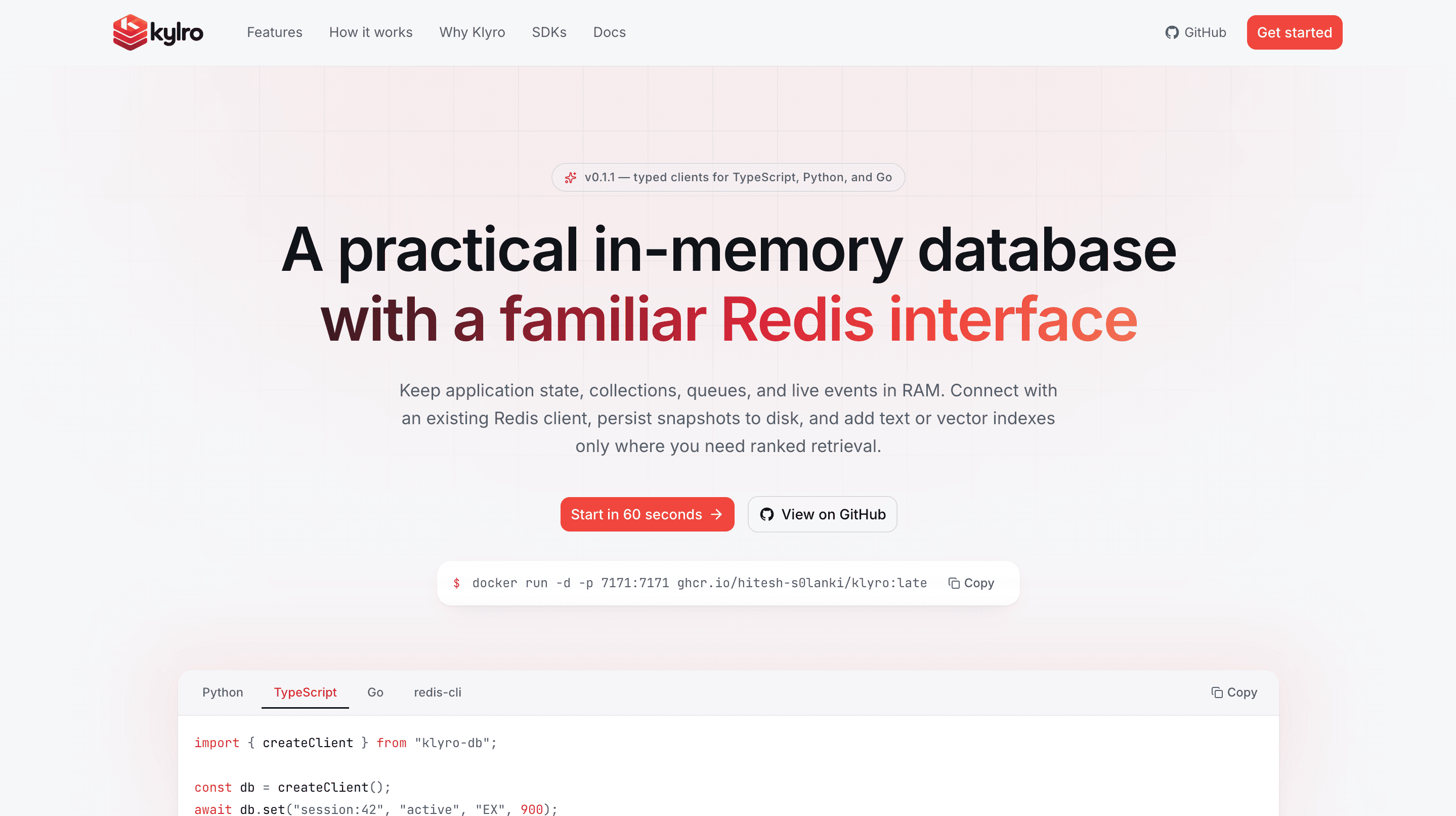
Klyro
Developer-first in-memory database written in Rust. Klyro speaks Redis's RESP protocol and supports familiar data structures, transactions, pub/sub, persistence, eviction policies, and keyword, vector, and hybrid retrieval in the same keyspace.
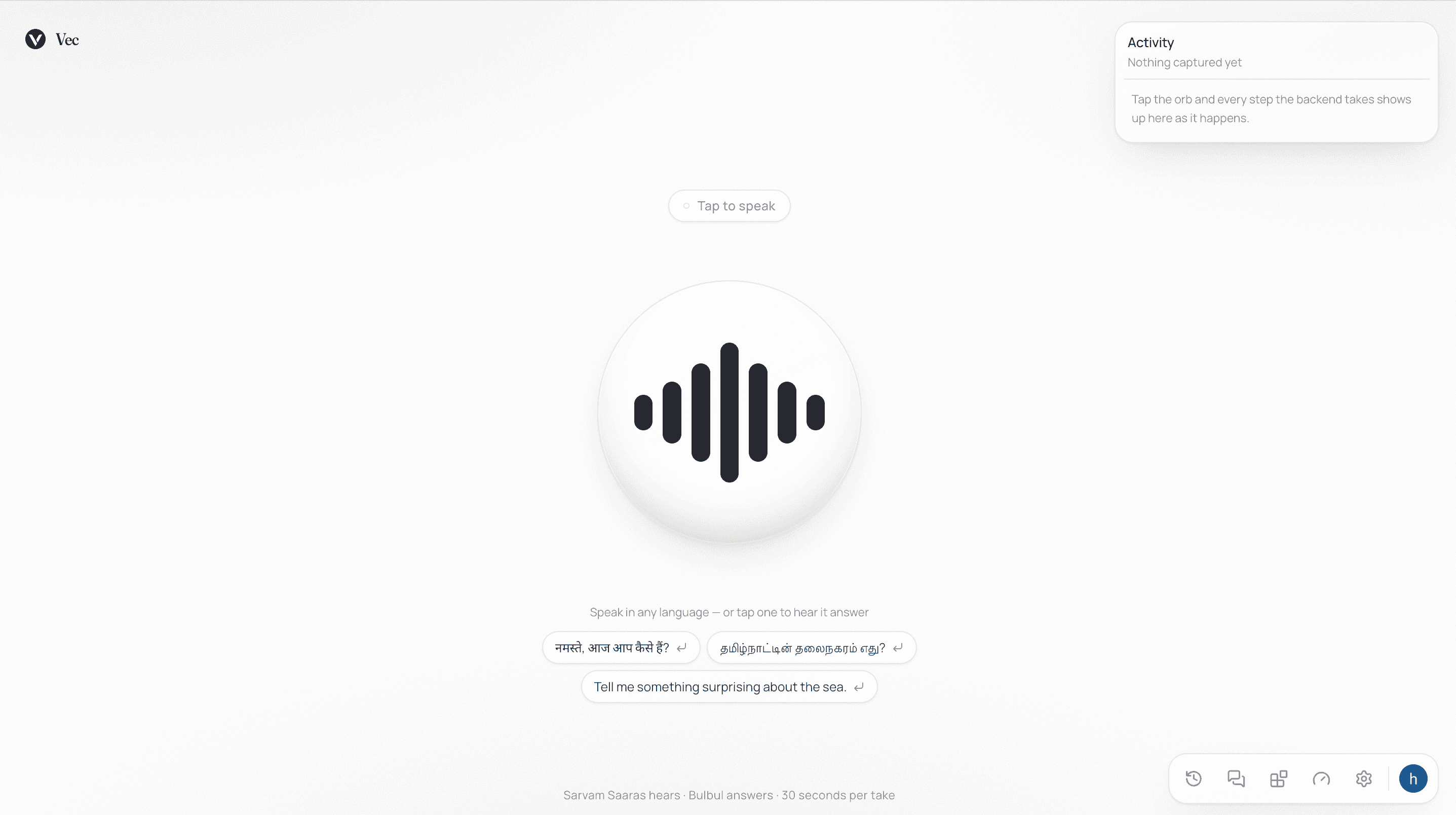
Vec
Multilingual voice assistant — speak in any of twenty-two languages and hear a reply about a second after you stop talking. Sarvam's Saaras and Bulbul models handle hearing and speaking, OpenAI writes the replies, and a connectors system lets each user wire in their own vector store, dataset, or tool with no shared corpus.