Multi-namespace MCP server in Go
Relivo MCP Server
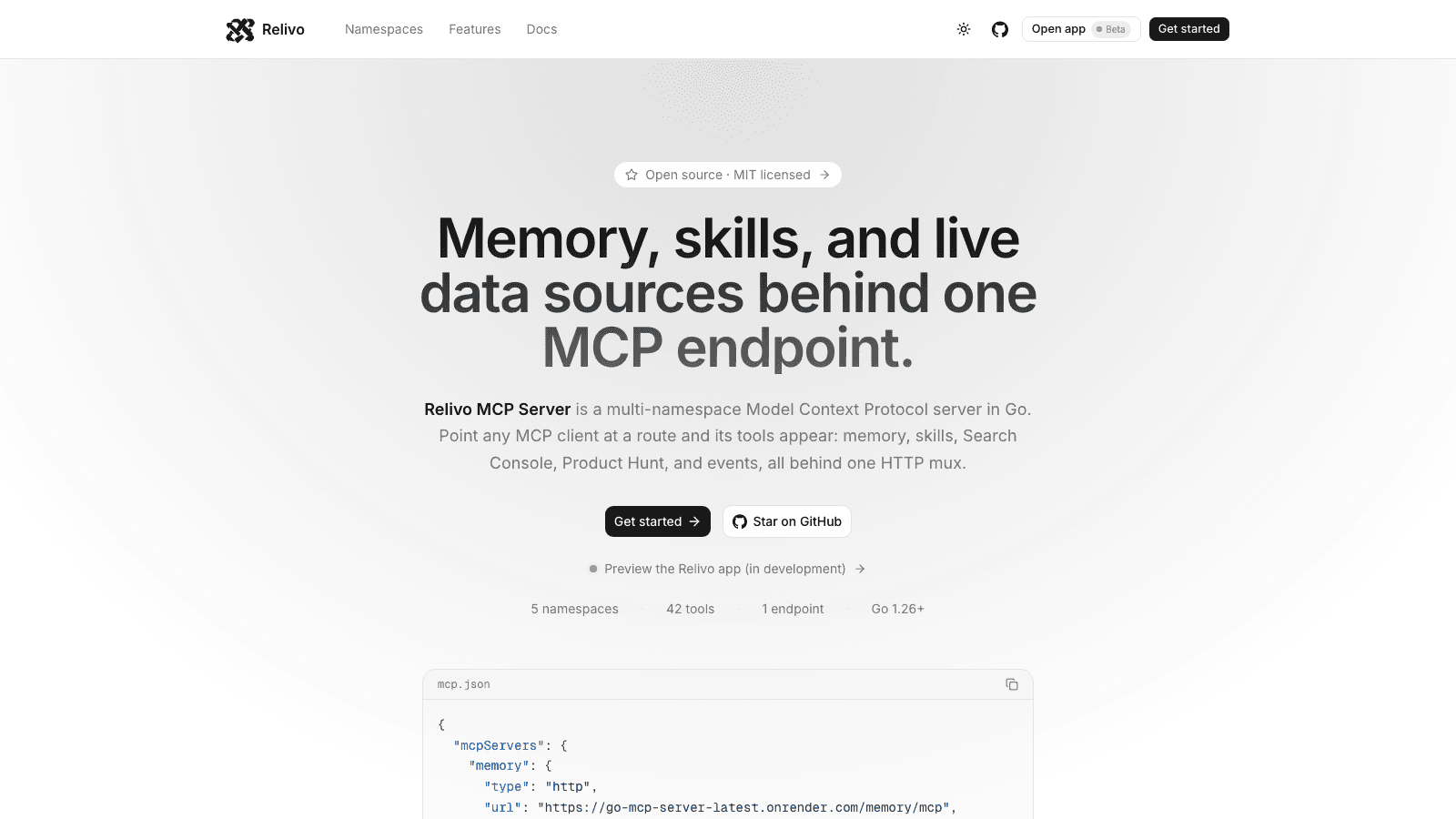
Multi-namespace Model Context Protocol server in Go — memory, skills, events, Search Console, and Product Hunt tools mounted on one HTTP mux over Streamable HTTP. Namespaces self-register at startup, and every route is admitted by its own auth: API keys for MCP clients, Clerk for the dashboard.
Documentation
go-mcp-server
Multi-namespace Model Context Protocol server in Go. Each namespace is an independent MCP server mounted on one HTTP mux over the Streamable HTTP transport:
| Route | Namespace | Purpose |
|---|---|---|
/memory/mcp | memory | Memory storage & recall tools |
/skills/mcp | skills | Web search & scrape (Firecrawl) |
/event/mcp | event | Kafka produce/consume (Confluent) |
/gsc/mcp | gsc | Google Search Console tools |
/producthunt/mcp | producthunt | Product Hunt API v2 (read) tools |
Namespaces self-register at startup, so adding a new one is a single package with an init() — main.go never changes. Router is stdlib net/http; a domain never reaches across another domain except through internal/mcpx.
Architecture
Two things are worth seeing before the section-by-section detail: how a request flows at runtime, and how the namespaces get mounted at startup.
Request lifecycle
Every request passes global middleware (panic recovery, then logging), hits the stdlib mux, and is admitted by the auth that belongs to that route — X-API-Key for the MCP namespaces, Clerk for the dashboard's key API, nothing for the liveness probe. Auth is per-route, not global, so a namespace can't forget it and /healthz never needs a credential.
flowchart TD
C["MCP client / browser<br/>(sends X-API-Key)"]
C --> R["Recover · panic → 500"]
R --> L["LogRequests · arrival + completion"]
L --> MUX{"net/http mux<br/>route match"}
MUX -->|"GET /healthz"| HZ["200 ok · no auth"]
MUX -->|"/*/mcp"| AK{"RequireAPIKey<br/>key in api_keys?"}
MUX -->|"/api/keys"| CK{"Clerk RequireUser<br/>signed-in human?"}
AK -->|"missing / unknown → 401"| X1["reject"]
CK -->|"no session → 401"| X2["reject"]
AK -->|"ok"| NS
CK -->|"ok"| KEYS["keysapi<br/>list / create / delete<br/>(owner-scoped)"]
subgraph NS["Namespace MCP servers · Streamable HTTP"]
MEM["/memory/mcp<br/><i>also scopes rows to key id</i>"]
SK["/skills/mcp"]
EV["/event/mcp"]
GSC["/gsc/mcp"]
PH["/producthunt/mcp"]
end
NS --> TOOL["tools/call → handler"]
RequireAPIKey only admits the caller. The memory namespace additionally resolves the same key to an api_key_id to scope every row — identity, not admission — reusing the resolver's warm cache so the second lookup is a map hit. See § Auth.
Startup & self-registration
Each domain package calls mcpx.Register from its init(), so importing the package is enough to enroll its namespace. mcpx.Handler then builds every registered server, failing fast if any can't (missing dependency, bad config) rather than mounting a half-working server that only breaks on the first tool call. cmd/server/main.go never enumerates namespaces — adding one is a new package plus a blank import.
flowchart LR
    subgraph INIT["package init() · self-register"]
        A["memory"]
        B["skills"]
        D["event"]
        E["gsc"]
        F["producthunt"]
    end

    A & B & D & E & F -->|"mcpx.Register(ns)"| REG["mcpx registry"]

    MAIN["cmd/server/main.go"] --> H["mcpx.Handler(opts)"]
    REG --> H
    H --> BUILD["ns.Server(deps)<br/>for each namespace<br/><i>fail fast on error</i>"]
    BUILD --> MOUNT["mux.Handle(path,<br/>RequireAPIKey(server))"]
Stack
- Go 1.26+
- github.com/modelcontextprotocol/go-sdk — official MCP SDK (Streamable HTTP handler, tool registration)
- stdlib
net/http— mux + middleware log/slog— structured logging
Layout
cmd/server/main.go     # config, graceful shutdown
internal/
  auth/                # X-API-Key format + resolver (api_keys table)
  mcpx/                # registry, Handler(), Chain(); integration test
  memory/              # per-user memories, hybrid RAG (Postgres + pgvector)
  skills/              # skills_find agent + skills_download + web primitives
  event/               # Kafka produce/consume over Confluent Cloud
  gsc/                 # Google Search Console (searchconsole/v1)
  producthunt/         # Product Hunt API v2 (GraphQL), read-only
frontend/              # Next.js docs + landing site (see § Frontend)
internal/mcpx/integration_test.go drives a real MCP client through
initialize + tools/call against the namespaces over an in-process
Streamable HTTP server.
Auth
Every namespace requires an X-API-Key header carrying a key from the
api_keys table. mcpx.RequireAPIKey enforces this in the middleware chain, so
admission is checked once at the transport rather than per-tool — a namespace
cannot forget it. Unknown or malformed keys get a 401 before dispatch.
GET /healthz is the one exempt route: an uptime probe needs no credential, and
it reveals only liveness.
The memory namespace additionally resolves the same key to an api_key_id
and scopes every row to it. That is identity, not admission — which is why the
check exists in both places.
Keys are minted, never auto-provisioned (auth.GenerateKey /
Resolver.Create). Clients set the header in their MCP config; see
.mcp.json.
skills namespace
An on-demand skill agent, a complete-skill downloader, and the raw web primitives they are built on. Nothing is stored — every call reflects live GitHub, so the catalogue is always current and the server holds no skill data.
skills_find— the headline tool, and the go-to for obtaining any skill. Give it a natural-language requirement ("edit a PDF form", "build an MCP server") and it runs a live OpenAI tool-calling loop over the Firecrawl tools: search GitHub → pick the best Agent Skill → fetch its fullSKILL.md→ return the complete, ready-to-use skill with source links. Pass multiple requirements viarequirements: [...]and they are resolved in parallel (one agent each, bounded fan-out), so batching is much faster than one call per need.skills_download— once you've located a skill, this downloads the whole package: every file in the skill folder (SKILL.md+ scripts + reference files, recursively) via the GitHub contents API, fetched concurrently. Takes a GitHub URL (repo/tree/blob/raw) orowner/repo/path.firecrawl_search— web search returning ranked results (url, title, description); setscrape=trueto also inline each page as markdown.firecrawl_scrape— fetch one URL as clean markdown (optionally raw HTML).
skills_find(requirements[])          skills_download(source)
   │  one OpenAI agent per need          │  GitHub contents API
   │  (parallel, bounded)                ├─ list skill dir (recursive)
   ├─▶ search_github ─┐                  └─ fetch every raw file (concurrent)
   └─▶ fetch_url ─────┴ Firecrawl        ▼
   ▼                                  complete skill: all files, in full
complete SKILL.md + sources
Config: FIRECRAWL_API_KEY powers the web tools (optional — without it Firecrawl
uses a lower unauthenticated rate limit, so those tools mount either way).
skills_find additionally needs OPENAI_API_KEY (and honours
SKILLS_AGENT_MODEL, default gpt-4o-mini); it is skipped when that key is
absent. skills_download needs no key — it reads public repos through GitHub's
public API unauthenticated. None are hard startup dependencies (unlike memory,
which requires Postgres).
gsc namespace — Google Search Console
Tools over the official Search Console API
(google.golang.org/api/searchconsole/v1, which subsumes the legacy Webmaster
Tools webmasters/v3 surface): search-analytics reporting, URL inspection, and
sitemap/property management.
This is a Go port of the Python AminForou/mcp-gsc
server, adapted for a headless Streamable-HTTP server: authentication is
service-account / Application Default Credentials only — there is no interactive
OAuth browser flow — and every mutating call is gated behind
GSC_ALLOW_DESTRUCTIVE. The port covers the full API surface (Sites, Sitemaps,
Search Analytics, URL Inspection); the reference server's interactive-only tools
(reauthenticate, get_creator_info) are intentionally dropped.
17 tools, all prefixed gsc_:
| Group | Tools |
|---|---|
| Meta | gsc_capabilities (auth status + tool catalogue; call this first if a tool errors) |
| Properties | gsc_list_properties, gsc_get_site_details, gsc_add_site†, gsc_delete_site† |
| Search traffic | gsc_search_analytics, gsc_advanced_search_analytics, gsc_performance_overview, gsc_compare_periods, gsc_search_by_page_query |
| URL inspection | gsc_inspect_url, gsc_batch_inspect_urls (≤10), gsc_check_indexing_issues (≤10) |
| Sitemaps | gsc_list_sitemaps, gsc_get_sitemap, gsc_submit_sitemap†, gsc_delete_sitemap† |
† Mutating — requires GSC_ALLOW_DESTRUCTIVE=true.
Config:
GSC_CREDENTIALS_PATH— path to a service-account JSON key. The account must be added as a user on each property (Search Console → Settings → Users and permissions), or hold domain-wide delegation. Unset ⇒ Application Default Credentials (GOOGLE_APPLICATION_CREDENTIALS, gcloud, or the metadata server).GSC_DATA_STATE— default freshness for analytics:all(default) orfinal. Per-calldata_stateoverrides it.GSC_ALLOW_DESTRUCTIVE— enable the mutating tools (default off).
Like skills (and unlike memory), missing credentials are not a startup
failure: the namespace always mounts and each tool reports the problem, so the
rest of the server still boots. gsc_capabilities surfaces the live auth status.
producthunt namespace — Product Hunt API v2
Read tools over the Product Hunt API v2,
a single GraphQL endpoint (https://api.producthunt.com/v2/api/graphql). The
namespace ships a tiny GraphQL client plus typed tools over posts, topics,
collections, users and comments, and a raw-query escape hatch. Read-only — no
mutations are exposed.
11 tools, all prefixed producthunt_:
| Group | Tools |
|---|---|
| Meta | producthunt_capabilities (auth status + tool catalogue; call this first if a tool errors) |
| Posts | producthunt_list_posts, producthunt_get_post, producthunt_get_post_comments |
| Topics | producthunt_list_topics, producthunt_get_topic |
| Collections | producthunt_list_collections, producthunt_get_collection |
| Users | producthunt_get_user, producthunt_viewer |
| Escape hatch | producthunt_graphql (run an arbitrary GraphQL query) |
Config — one of two credential styles, resolved in order:
PRODUCTHUNT_TOKEN— a non-expiring developer token from the API dashboard. Simplest; used directly as the bearer token.PRODUCTHUNT_DEVELOPER_TOKEN/PRODUCTHUNT_ACCESS_TOKENare accepted as aliases.PRODUCTHUNT_CLIENT_ID+PRODUCTHUNT_CLIENT_SECRET— the OAuth2 client-credentials ("client-only") flow. When no developer token is set, the server fetches a public-scope token lazily on first use and caches it.
Like skills and gsc (and unlike memory), missing credentials are not a
startup failure: the namespace always mounts and each tool reports the problem.
producthunt_capabilities surfaces the live auth status. producthunt_viewer
additionally needs a user-scoped token — client-credentials tokens have no viewer.
event namespace — Kafka (Confluent Cloud)
A worked example of realtime event-driven architecture: produce and consume
tools an agent uses to put messages on a Kafka topic and read them back, over
Confluent Cloud. The client is pure-Go segmentio/kafka-go;
the connection is SASL_SSL, mechanism PLAIN (Confluent API key = SASL username,
API secret = password), TLS with system roots.
6 tools, all prefixed event_:
| Tool | Purpose |
|---|---|
event_capabilities | Config + readiness (broker, auth, default group/topic, admin gate, owner-scoping) + tool catalogue. No network. Call first if a tool errors. |
event_publish | Produce one message (topic, key, value, headers). Stamps the caller's api_key_id as an authoritative x-mcp-owner header. Returns the partition + offset + owner. |
event_consume | Bounded poll: read up to max messages within timeout_ms. Returns only the caller's own events — the group is per-caller and every record is validated against the caller's x-mcp-owner. from=group (default) advances a durable per-caller cursor; earliest/latest peek partition 0. |
event_topics | List topics + partition counts (read-only). |
event_create_topic / event_delete_topic | Topic admin — gated behind KAFKA_ALLOW_TOPIC_ADMIN. |
event_publish(topic,key,value)          event_consume(topic,group,max,from)
   │  key -> hash partition                 │  ephemeral reader per call
   │  Client.Produce (real offset)          ├─ FetchMessage until max or timeout
   ▼                                        └─ CommitMessages (group mode)
 partition + offset                         ▼
        │        ├──── Confluent Cloud (SASL_SSL / PLAIN / TLS) ────┤
        │        │                                                  ▼
 event_topics ───┘                    []{partition,offset,key,value,headers,ts}
 event_create_topic / event_delete_topic   (gated: KAFKA_ALLOW_TOPIC_ADMIN)
Config: KAFKA_BOOTSTRAP_SERVERS, KAFKA_API_KEY, KAFKA_API_SECRET enable the
tools; KAFKA_CONSUMER_GROUP (default go-mcp-server) and KAFKA_DEFAULT_TOPIC
set defaults; KAFKA_ALLOW_TOPIC_ADMIN gates topic create/delete. Like skills,
gsc and producthunt (and unlike memory), missing config is not a startup
failure: the namespace always mounts and each tool reports the problem;
event_capabilities surfaces the status. On Confluent Cloud, created topics must
use replication factor 3 (the default).
Per-caller event scoping. Like memory, event resolves the X-API-Key to a
non-secret api_key_id and treats it as the event's owner. event_publish
stamps that id on every record as an authoritative x-mcp-owner header (any
client-supplied owner header is stripped, so ownership cannot be forged);
event_consume reads a per-caller consumer group (<group>.<api_key_id>, an
isolated cursor) and returns only records whose owner matches — other users'
events on a shared topic are committed past but never surfaced. This makes each
event unique to its user: the same key that admits the request is what scopes
what it can read. The credential itself is never written to a record — only the
api_key_id. Scoping needs DATABASE_URL (the api_keys resolver); without it
publish/consume report the missing dependency rather than serving events
unscoped.
Frontend
frontend/ is a Next.js app (App Router, Tailwind,
shadcn/ui) that serves the project's landing page and namespace documentation
under /doc. Every connection URL shown in the docs is derived at render time
from NEXT_PUBLIC_MCP_BASE_URL (see frontend/.env.local),
so pointing it at a tunnel or prod host rewrites every example — nothing is
hard-coded.
cd frontend
npm install
npm run dev          # http://localhost:3001
The tool catalogue rendered in the docs lives in src/lib/docs.tsx; keep it in
sync with the Go tools when a namespace changes.
Quick start
cp .env.example .env
make run
The server listens on :8080 (override with PORT). Point an MCP client at, e.g., http://localhost:8080/memory/mcp.
Adding a namespace
- Create
internal/<name>/with aregister.gothat callsmcpx.Registerfrominit(). - Blank-import the package in
cmd/server/main.go.
That's it — the mux picks it up on the next start.
Development
make on its own lists every target.
| Target | Does |
|---|---|
make run | Run the server (loads .env if present) |
make build | Compile to bin/ |
make test | Run all tests (testv for verbose) |
make cover | Coverage report in the browser |
make check | fmt + vet + lint + test — run before a PR |
make lint | golangci-lint (skipped if not installed) |
make lintfix | Lint with --fix for auto-fixable issues |
make health | Curl /healthz on a running server |
make tunnel | Expose the local server publicly via ngrok |
make clean | Remove bin/ and coverage artifacts |
Public tunnel
To point a hosted MCP client at your local server, run the server and the tunnel in two terminals:
MCP_ALLOW_EXTERNAL_HOST=true make run   # terminal 1
make tunnel                             # terminal 2
MCP_ALLOW_EXTERNAL_HOST=trueis required behind a tunnel. The MCP transport has DNS-rebinding protection that rejects any request arriving on a loopback address with a non-loopbackHostheader — precisely what ngrok does. Without it every MCP request fails with403 Forbidden: invalid Host header, while/healthzstill returns 200 (it doesn't go through the transport), which makes the server look healthy. Set it only when a trusted proxy is in front. It lives in.env.example.
Namespaces are then reachable at https://<NGROK_URL>/memory/mcp and friends.
Override the defaults if needed: make tunnel NGROK_URL=your.ngrok-free.app PORT=9000.
Connecting a client
.mcp.json registers every namespace as a Streamable HTTP server, pointing
at the ngrok domain by default. Clients that read project-scoped MCP config
(e.g. Claude Code) pick it up automatically.
To point at a local server instead of the tunnel, override the base URL:
MCP_BASE_URL=http://localhost:8080 claude
Linting
Config lives in .golangci.yml (golangci-lint v2 schema). On top of the
defaults (errcheck, govet, ineffassign, staticcheck, unused) it enables
checks that matter for an HTTP server — bodyclose, noctx, errorlint,
nilerr, gosec — plus sloglint for the logging style and revive for
exported-symbol docs.
Formatting is gofmt + goimports driven through golangci-lint fmt, with
this module's imports grouped into their own block. Run make fmt, not bare
gofmt, so the import grouping stays consistent.
brew install golangci-lint   # if you don't have it
make lint
License
MIT
Keep exploring
Related work
Dioramic
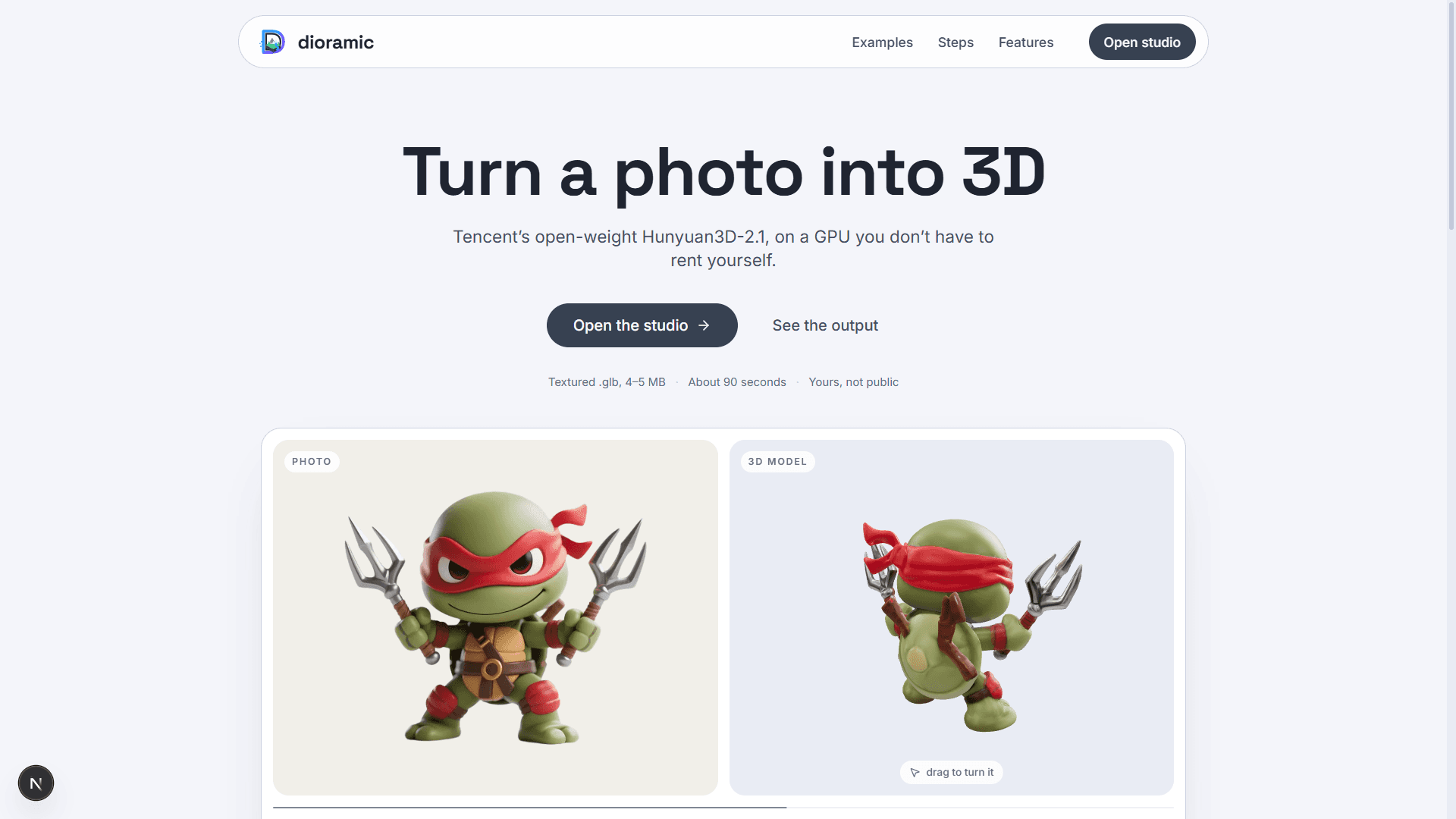
Photo-to-3D web app — upload a picture and a rented GPU turns it into a textured mesh, private to your account. Runs open-source models (TripoSR, Hunyuan3D-2.1, GroundingDINO) on Modal, with photos and meshes in Vercel Blob and every run tracked in Neon Postgres.
Resonance
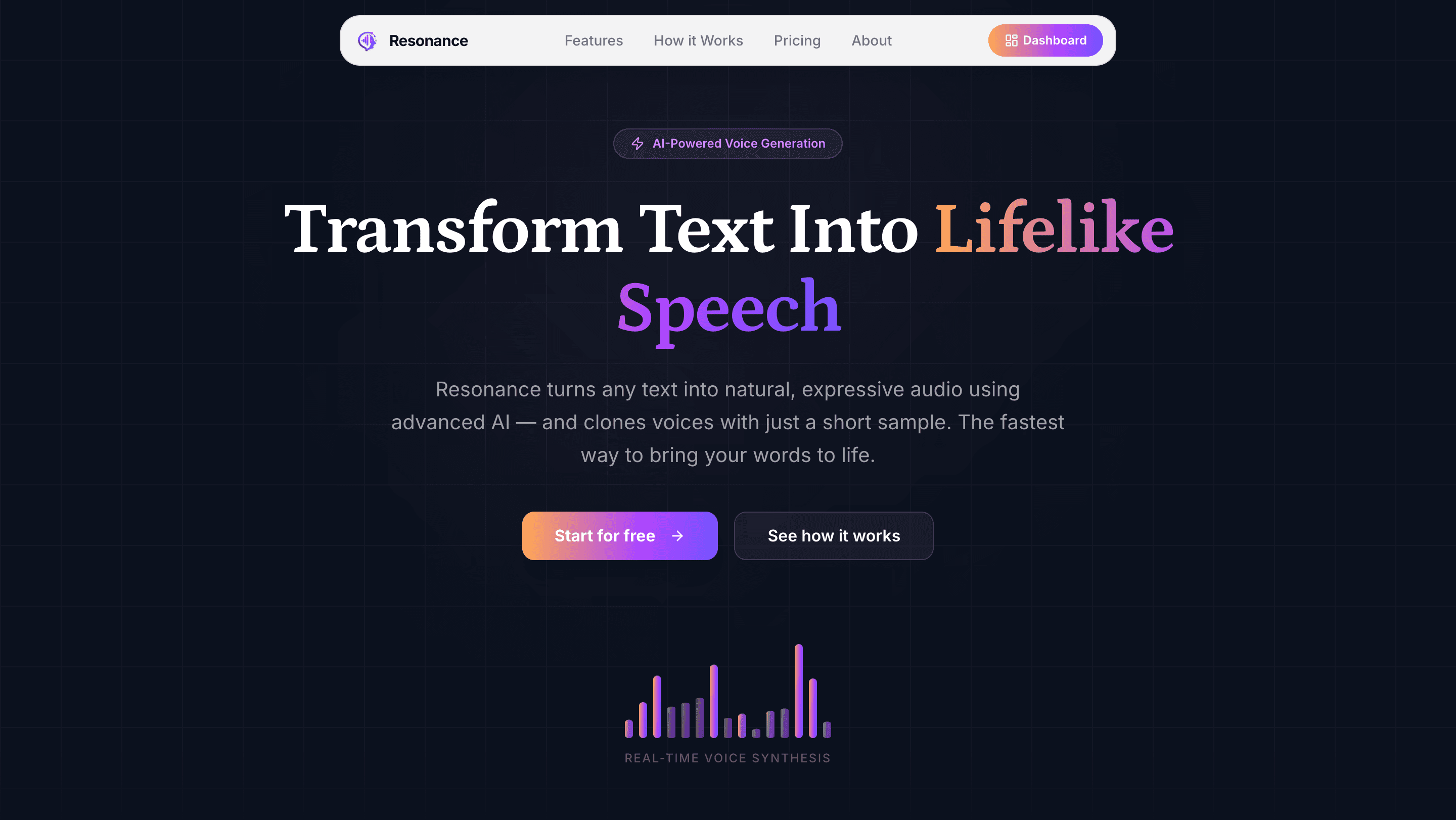
AI-powered text-to-speech and voice cloning platform for organisations, with custom voice uploads, browser recording, usage-based billing, and a managed voice library.
Bookify
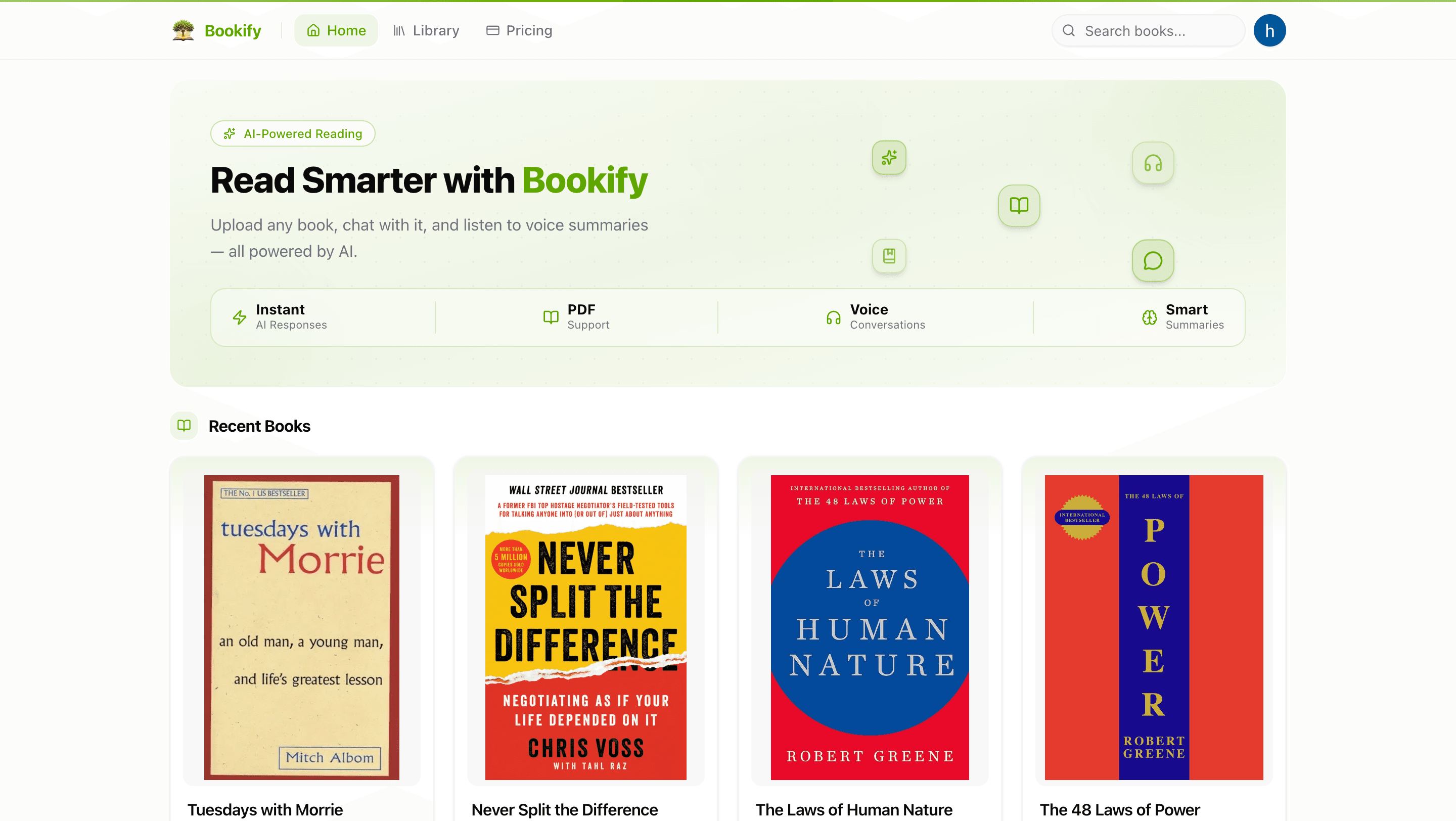
AI-powered reading companion — upload a PDF book, get an AI-generated overview, chat with the content via RAG, and have live voice conversations about it.